Business Management Software for Product vs Service Businesses: Which One Does Your Business Need?
Choosing business management software is not simply about finding a system with the most features.
The better question is:
Does the software match the way your business actually operates?
A product-based business and a service-based business may both need customers, invoices, expenses and reports. But the way they sell, deliver and manage what they offer can be very different.
A product business may depend heavily on inventory, stock levels, purchasing and product movement. A service business may depend more on customers, quotations, services, work orders, invoicing, collections, staff and branch operations.
That difference is important when choosing business management software in the UAE.
If you run a service business, using software designed primarily around products, stock and inventory may leave important parts of your daily workflow outside the system.
This is why service businesses should look at software from a different perspective.
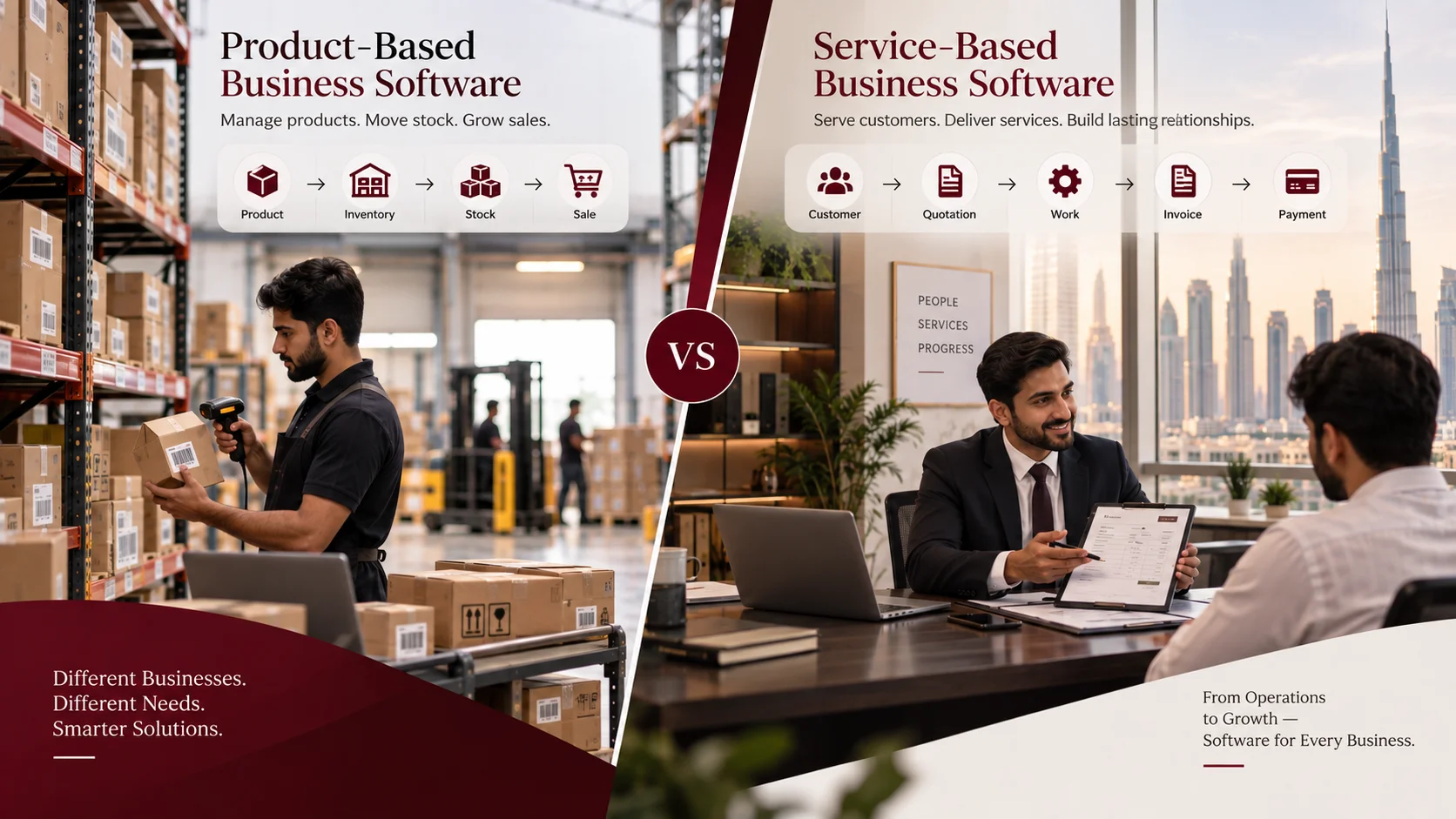
Product-Based Business Software vs Service-Based Business Software
Before choosing a software solution, it helps to understand the fundamental difference between the two business models.
What is a product-based business?
A product-based business sells physical or digital products.
Examples include:
- Retail shops
- Wholesalers
- Distributors
- Trading companies
- E-commerce businesses
- Manufacturers
For these businesses, products themselves are at the centre of daily operations.
A typical workflow may look like:
Purchase → Inventory → Product Sale → Payment → Delivery
As the business grows, inventory and purchasing can become increasingly important.
What is a service-based business?
A service-based business sells an activity, process, expertise or service rather than primarily selling physical stock.
Examples include:
- Typing centres
- ID centres
- Travel agencies
- PRO service providers
- Document-clearing companies
- Business setup companies
- Other service-based SMEs
The workflow can look very different:
Customer → Service → Quotation → Work → Invoice → Payment → Follow-up
The business may not need a large inventory system at the centre of its operations.
Instead, it needs to manage the relationship between customers, services, quotations, transactions, employees, payments and operational work.
That is where the distinction between product business software and service business software becomes important.
Product Business Software: What Does It Usually Focus On?
Product-based businesses often need software that helps them control the movement of products.
Inventory management
Inventory can be one of the most important areas.
Businesses may need to know:
- What products are available?
- How many units are in stock?
- What has been purchased?
- What has been sold?
- What needs to be reordered?
- Which supplier provided the product?
Purchasing and suppliers
Product businesses often purchase stock before selling it.
This makes purchasing, suppliers and stock costs important parts of the business workflow.
Sales and fulfilment
The process may continue from:
Product → Sale → Payment → Delivery
For a business where physical goods are central, software needs to keep track of that movement.
Product-based reporting
Management may want to understand:
- Product sales
- Stock levels
- Purchasing
- Supplier activity
- Inventory value
- Sales performance
For these businesses, inventory and product management can therefore be major software-selection criteria.

Service Business Software: What Does It Need to Focus On?
Now consider a service business.
There may be no warehouse full of products. Instead, the business may have hundreds of customers, dozens of services, quotations, pending transactions, employees and payments being handled every day.
The important question becomes:
How do we manage the entire customer-to-payment workflow?
Customer management
The customer is often at the centre of a service transaction.
A business may need to maintain:
- Customer details
- Customer history
- Services requested
- Quotations
- Invoices
- Payments
- Outstanding balances
Service management
Instead of managing hundreds of physical products, a service business may manage a catalogue of services.
For example:
Customer → Select Service → Quote → Process Service → Invoice
Software should make that workflow easier to manage.
Quotations
Service businesses often need to provide a price before the service is completed.
That makes quotations an important part of the sales process.
Drafts and work orders
Some service transactions are not completed immediately.
A customer may request several services at different times.
The business may need to keep the transaction open, update it and eventually convert it into an invoice.
Billing and collections
The final invoice is only one part of the process.
The business may also need to know:
- What has been paid?
- What is still pending?
- Which customers have outstanding balances?
- What collections were made?
- What advances were received?
If you want to explore this topic in more detail, see our guide on how to track outstanding payments in a service business for practical ways to manage invoices, payments, outstanding balances and collections.
Staff and branch management
Service businesses can also depend heavily on employees.
One employee may handle the customer.
Another may process the service.
A manager may monitor the branch.
If the business has several locations, management also needs visibility across branches.
Reporting
At the management level, the business needs more than invoices.
It needs information about:
- Sales
- Collections
- Expenses
- Customers
- Staff
- Branches
- Profitability
- Financial activity
This is why service business management software needs to go beyond simple invoice generation.
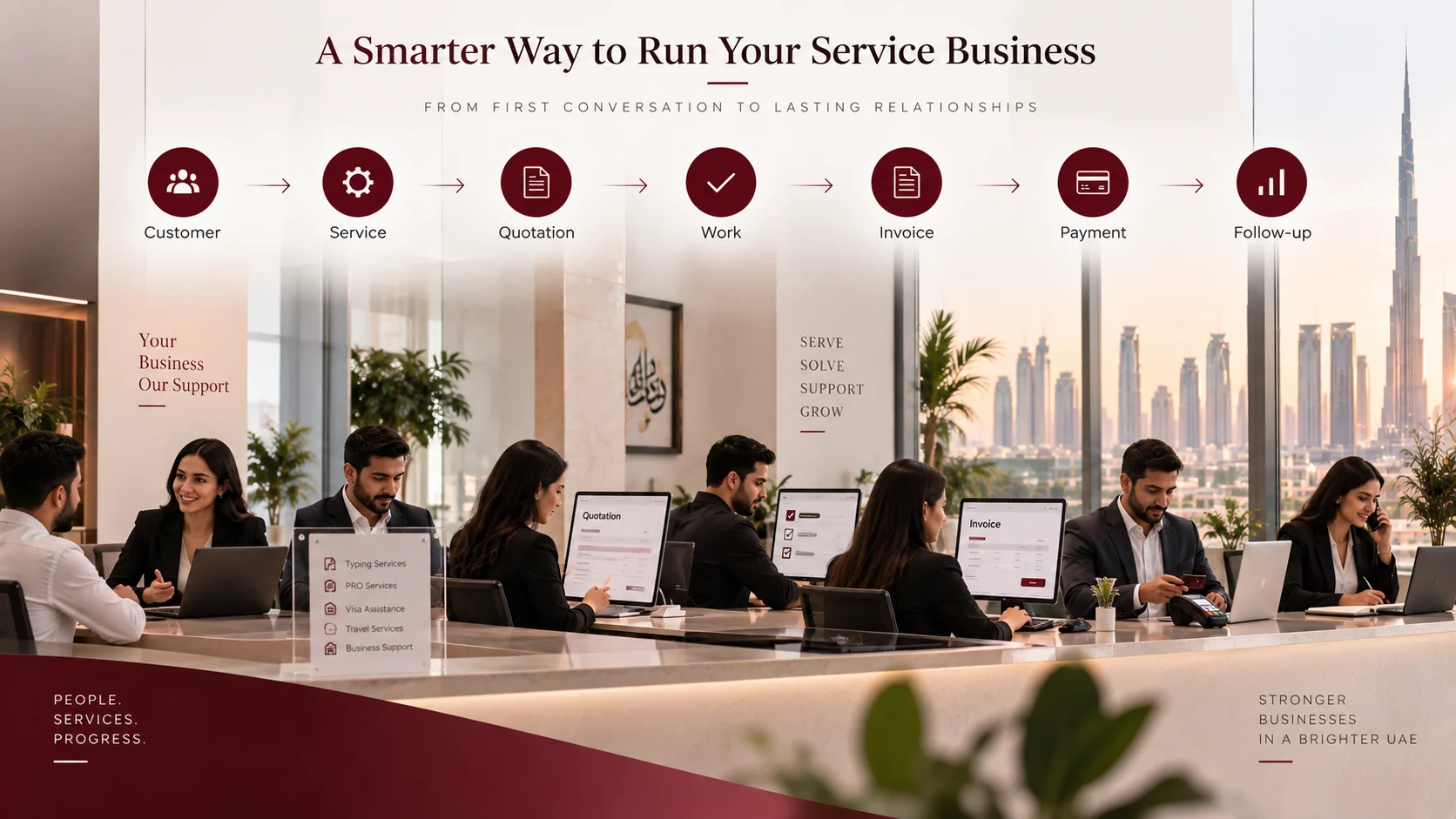
Product Business Software vs Service Business Software: The Key Difference
The simplest way to understand the difference is to look at what each business needs to manage most closely.
| Business requirement | Product-based business | Service-based business |
|---|---|---|
| Product catalogue | Important | May be less important |
| Inventory | Often central | May be less central |
| Stock tracking | Often central | Usually less central |
| Purchasing | Often important | Depends on business |
| Customers | Important | Often central |
| Services | Usually secondary | Often central |
| Quotations | Useful | Often important |
| Drafts | Depends | Can be important |
| Work orders | Depends | Can be important |
| Invoicing | Important | Important |
| Collections | Important | Important |
| Customer balances | Important | Often important |
| Expenses | Important | Important |
| Staff management | Depends | Often relevant |
| Branch management | Depends | Often relevant |
| Operational reporting | Important | Important |
These are general workflow differences, not strict rules.
Some product businesses need sophisticated service management.
Some service businesses also have inventory.
But the distinction is useful when deciding what should be at the centre of your software.
Why Generic Business Software May Not Always Be the Right Fit
Search for business management software in the UAE and you will find many platforms covering areas such as accounting, sales, inventory, CRM, HR and general operations.
That broad functionality can be useful for businesses with complex general-purpose requirements.
But there is another question worth asking:
How closely does the software match my actual workflow?
Imagine a typing centre.
Its daily activity may involve:
Customer → Service → Quotation → Draft → Processing → Invoice → Collection → Expense → Report
If the software is primarily structured around:
Product → Stock → Purchase → Warehouse → Sale
then employees may have to adapt their business process around the software.
For a service business, that can create unnecessary steps.
If you are still managing customers, quotations, payments and daily operations through Excel or spreadsheets, these may be signs that your current system is no longer keeping up with your business: 5 Signs Your Service Business Has Outgrown Excel
The goal should be the opposite.
The software should fit the workflow.
What Should Service Businesses Look for in Business Management Software?
If you operate a service business in the UAE, start by looking for these capabilities.
1. Customer management
Can you maintain customer information and transaction history in one place?
2. Service management
Can you organize the services your business provides?
3. Quotations
Can you prepare and manage quotations before billing?
4. Draft-based workflows
Can you keep pending service items before converting them into invoices?
5. Work orders
Can you track operational work where your business requires it?
6. Invoicing
Can you create invoices without repeating information already entered elsewhere?
7. Payment and collection tracking
Can you understand outstanding balances and collections?
8. Expense management
Can you record and categorize business expenses?
9. Staff and users
Can employees use the system while management maintains appropriate visibility and access?
10. Branch management
Can you manage multiple branches if your business operates in different locations?
11. Reporting
Can management see the information required to make day-to-day decisions?
When these capabilities work together, the software becomes more than a billing tool.
It becomes part of the business workflow.
Where Does Khadamath Fit?
This is where the comparison becomes particularly relevant.
Khadamath is built specifically around service-provider workflows in the UAE.
Its public software page positions it for Typing Centres, ID Centres, Travel Agencies and other Service Providers across the UAE, rather than positioning it primarily around inventory-driven businesses.
Khadamath includes functionality for:
- Services
- Invoicing
- Quotations
- Drafts
- Customers
- Work Orders
- Expenses
- Suppliers
- Staff
- Branches
- Users
- Packages
- Collections
- Customer Advances
- Business reports
This makes the service-business workflow much clearer.
Instead of thinking about software as simply:
Create Invoice → Receive Payment
a service business can think about the broader process:
Customer → Service → Quotation → Draft → Work Order → Invoice → Collection → Expenses → Reports
That is the kind of workflow Khadamath is designed to support.
Why a Service Business Can Benefit From Khadamath
The important point is not simply that Khadamath has many features.
It is that its documented features correspond to the activities that service businesses commonly need to manage.
From customer to quotation
A customer can be maintained within the system while quotations can be created for requested services.
From quotation to service
Drafts and work orders can support the process between an initial request and final billing.
From service to invoice
Completed services can move into the invoicing workflow.
From invoice to collection
The business can track billing and collections rather than treating the invoice as the end of the process.
From transactions to management
Expenses, suppliers, staff, branches and reports extend the workflow beyond individual invoices.
Khadamath's public product information specifically describes features for multi-user access, branches, customer records, pending payments, credit balances and reporting.
Khadamath for UAE Service Businesses
Khadamath's documented target audience includes several types of service businesses.
Typing Centres
Typing centres often handle multiple customers and multiple services every day.
Khadamath supports relevant workflows around services, quotations, drafts, customers, work orders, billing, expenses, staff, branches and reporting.
ID Centres
ID centres are specifically included in Khadamath's stated service-provider audience.
Travel Agencies
Travel agencies are another service-business category identified by Khadamath.
PRO Service Providers
PRO businesses can have multiple customers, services, quotations, transactions and follow-ups, making service-oriented business management relevant to their workflow.
Document-Clearing Businesses
Document-clearing companies similarly operate around customers and services rather than simply moving physical stock.
Business Setup Companies
Business setup businesses may manage multiple customers, services, quotations, payments and operational activities.
Service-Based SMEs
Khadamath also targets broader service-based SMEs in the UAE.
What About Accounting?
A service business still needs financial visibility.
But accounting should not be viewed separately from operations.
Consider this workflow:
Customer → Service → Invoice → Payment → Expense → Profit
The operational transaction creates financial information.
Khadamath's Premium plan includes additional financial reporting such as Trial Balance, Balance Sheet and P&L Statement, alongside the broader operational features available in the platform.
This allows businesses to evaluate the software not simply as an invoice generator, but as a broader business-management solution for their service workflow.
Product Software or Service Business Software: Which Should You Choose?
The answer depends on what your business actually does.
If your business is heavily dependent on:
- Inventory
- Stock
- Warehouses
- Product purchasing
- Product movement
then product-oriented business software may be an important category to evaluate.
But if your business is primarily built around:
- Customers
- Services
- Quotations
- Work orders
- Invoicing
- Collections
- Expenses
- Staff
- Branches
- Reporting
then service-business software deserves much more attention.
And this is where a service-focused platform such as Khadamath becomes relevant.
Rather than forcing a service business into a product-centric workflow, Khadamath is built around the activities that service providers actually perform.
A Simple Way to Decide
Before choosing business management software, write down your daily workflow.
For example:
How does a customer enter your business?
↓
How do you provide a quotation?
↓
How do you process the service?
↓
How do you create the invoice?
↓
How do you collect payment?
↓
How do you track expenses?
↓
How do you monitor employees and branches?
↓
How does the owner see the results?
Now compare that workflow against the software.
If your business looks more like a service workflow than an inventory workflow, choosing software built around service operations can make much more sense.
The Bottom Line
The right business management software is not necessarily the one with the largest feature list.
It is the one that fits the way your business operates.
For product businesses, inventory, purchasing and stock movement may be central.
For service businesses, the centre of the operation can be very different:
Customers → Services → Quotations → Work → Billing → Collections → Expenses → Reporting
That is why service businesses should not evaluate software only through the lens of generic accounting or inventory management.
They should look for a platform that understands their workflow.
Khadamath is built around that service-business model for businesses in the UAE, with functionality covering customers, services, quotations, drafts, work orders, invoicing, collections, expenses, suppliers, staff, branches and reporting.
If your business is a typing centre, ID centre, travel agency, PRO service provider, document-clearing company, business setup company or another service-based business, the better question may not be:
“Which software has the most features?”
It may be:
“Which software is built around the way my service business actually works?”
That is the difference worth considering when choosing business management software in the UAE.

Ready to Manage Your Service Business More Efficiently?
See how Khadamath can help you manage customers, services, quotations, invoicing, collections, expenses and daily business operations in one place.
Talk to Khadamath