How to Track Outstanding Payments in a Service Business
Issuing an invoice is only one part of getting paid. A service business also needs to know which customers still have balances, when those payments are due, how much has already been received, what remains outstanding, and which payments need follow-up.
As the number of customers and transactions grows, keeping this information across separate spreadsheets, invoice files, payment records and messages can make payment tracking harder to manage.
Effective outstanding-payment tracking means recording each customer's invoice, due date, amount paid, remaining balance, payment status and follow-up activity in one organized workflow.
For a service business, that workflow can be thought of as:
Customer → Invoice → Due Date → Payment → Remaining Balance → Payment Status → Follow-up → Collection → Reporting

- What Are Outstanding Payments?
- What Should You Track for Every Customer Payment?
- How to Track Outstanding Payments Step by Step
- How to Handle Partially Paid Invoices
- How to Prioritize Outstanding Payments
- Common Problems With Manual Payment Tracking
- What Should Payment Tracking Software Provide?
- How Khadamath Helps Service Businesses Manage Outstanding Payments
- Conclusion
What Are Outstanding Payments?
An outstanding payment is an amount a customer still owes on a billed service. It may be due already, or it may still be within the agreed payment period.
An outstanding invoice is an invoice that has not been fully settled. The invoice can remain outstanding even when its due date has not yet passed.
Outstanding vs. Overdue Payments
These terms are related, but they are not the same.
| Status | What it means |
|---|---|
| Outstanding | The customer still has an unpaid balance. |
| Not yet due | The balance is outstanding, but the agreed due date has not passed. |
| Due | The payment is due according to the agreed terms or date. |
| Overdue | The due date has passed and the balance is still unpaid. |
| Partially paid | A payment has been received, but part of the invoice balance remains. |
| Paid | The outstanding amount has been fully settled. |
These labels do not always describe the same type of information. For example, an invoice can be partially paid and overdue at the same time. The business should therefore keep the payment status, payment amount and due-date information visible separately.
What Should You Track for Every Customer Payment?
A useful payment-tracking system should answer a simple question: “How much does this customer still owe, and what needs to happen next?” To answer that consistently, keep the important information connected.
| Information | Why it matters |
|---|---|
| Customer | Identifies who the balance belongs to. |
| Invoice number | Connects the balance to the correct invoice. |
| Invoice date | Shows when the invoice was issued. |
| Due date / payment terms | Shows when payment is expected. |
| Invoice amount | Shows the original amount billed. |
| Amount paid | Shows how much has already been received. |
| Remaining balance | Shows what is still outstanding. |
| Payment status | Shows whether the amount is not yet due, due, overdue, partially paid or paid. |
| Payment history | Shows previous payments related to the customer or invoice. |
| Follow-up status | Shows whether the outstanding amount needs attention and what action has been taken. |
The exact fields a business needs can vary by its processes, but these categories provide a practical starting point for maintaining visibility.
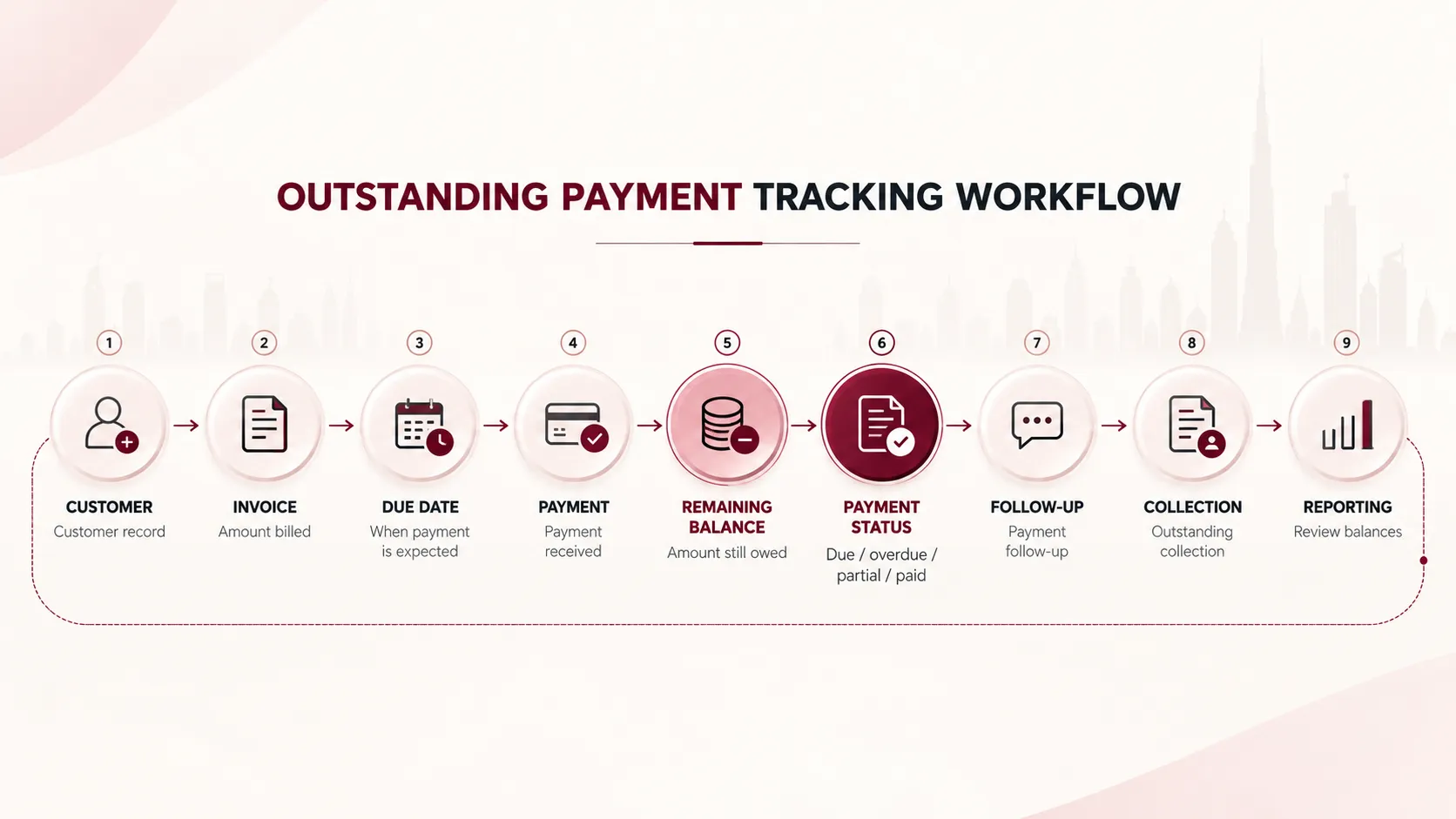
How to Track Outstanding Payments Step by Step
1. Record Every Customer Invoice
Begin by maintaining a complete invoice record for each customer. The record should make it clear who was billed, which invoice was issued, the amount charged, when it was created, and when payment is expected.
This gives the business a reliable reference for every later payment entry. Without that reference, it becomes harder to determine how much should have been collected and what balance is still open.
2. Record Payments Against the Correct Invoice
Each received payment should be linked to the customer and the specific invoice it settles. This becomes especially important when the same customer has multiple unpaid invoices.
A payment entry should provide enough information to determine which invoice was paid and what balance remains after the transaction.
3. Calculate the Remaining Balance
The remaining balance is the amount that has not yet been settled.
Remaining balance = Invoice amount − Payments received
For example, if a service invoice is AED 1,000 and the customer has paid AED 600, the remaining balance is AED 400.
The important point is to keep the original invoice amount, payments received and remaining balance visible rather than replacing the original amount with the latest figure.
4. Record Payment Status Separately From Payment Progress
A clear status helps the business understand an invoice at a glance. However, payment progress and due-date status should not always be treated as one sequence.
For example, an invoice can be:
- Not yet due — the payment deadline has not arrived.
- Due — payment is expected according to the agreed terms.
- Overdue — the agreed due date has passed without full settlement.
- Partially paid — some payment has been received, but a balance remains.
- Paid — the invoice balance has been fully settled.
These conditions can overlap. For example, an invoice may be both partially paid and overdue. Keeping the payment amount, remaining balance and due-date status visible separately gives the business a clearer picture of what is happening.
5. Review Outstanding Balances Regularly
Payment tracking is more useful when outstanding balances are reviewed regularly rather than only when cash becomes tight.
A review can focus on:
- Which customers have open balances?
- Which balances are already overdue?
- How much remains outstanding for each customer?
- Which invoices have received partial payments?
- Which balances require follow-up?
The review frequency should match the transaction volume and payment terms of the business. A service business with frequent transactions may need more frequent reviews than a business with a small number of monthly invoices.
Tracking outstanding payments is only one part of managing business finances. Learn how to track business expenses in a service business to understand outgoing costs alongside incoming payments.
6. Follow Up on Overdue Amounts
Once a payment becomes overdue, the business needs a clear follow-up process. The process may include checking the invoice, confirming the balance, reviewing previous communication and contacting the customer through the business's normal communication channel.
The goal of tracking is not simply to label an invoice as overdue. It is to make the next action visible.
7. Review Collections Through Reports
As the number of customers increases, customer-level records alone may not provide enough management visibility. Collection and statement reports can help management review outstanding amounts and customer billing activity in a more organized way.
How to Handle Partially Paid Invoices
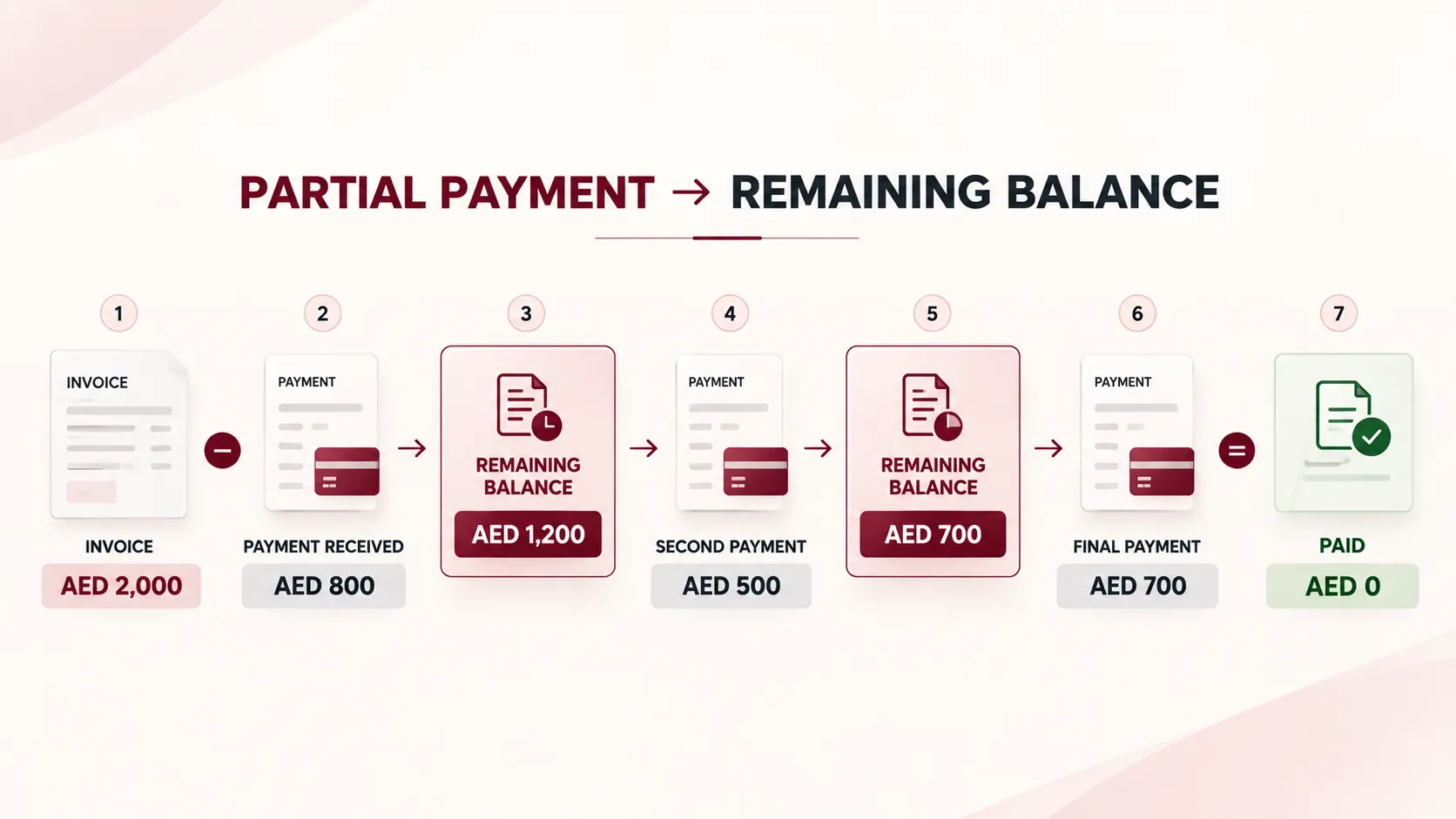
Partial payments are common in service businesses. A customer may pay a deposit, make a part payment after a service, or settle an invoice through several payments.
For example:
| Invoice Amount | Payment Received | Remaining Balance |
|---|---|---|
| AED 2,000 | AED 800 | AED 1,200 |
| AED 2,000 | AED 500 additional payment | AED 700 |
| AED 2,000 | AED 700 final payment | AED 0 |
The important part is to preserve the payment history. The latest remaining balance should not replace the record of how that balance was created.
This becomes especially important when a customer has several services or invoices. A clear customer-level view can help the business understand both individual invoices and the overall customer balance.
How to Prioritize Outstanding Payments
Not every outstanding amount requires the same immediate attention. A business can use several practical factors when deciding which balances to review first.
- How long the balance has been outstanding
- Whether the due date has passed
- The amount still remaining
- The customer's previous payment history
- Whether there is a dispute or billing issue
- Whether the customer has made a partial payment
Ageing is one useful way to organize outstanding balances. For example, a business may group amounts by current, 1–30 days, 31–60 days, 61–90 days and 90+ days. The exact ranges should reflect the business's payment terms and reporting needs.
The purpose of ageing is visibility and prioritization. It should not replace the underlying customer, invoice and payment records.
Common Problems With Manual Payment Tracking
Spreadsheets can record invoices and payments, but the process can become harder to manage when customer, billing and collection information is spread across multiple files.
Common operational problems include:
- Payment information stored separately from customer information
- Manual matching of payments to invoices
- Repeated calculation of customer balances
- Difficulty identifying overdue amounts quickly
- Missed or inconsistent follow-up
- Difficulty preparing customer statements
- Manual consolidation of collection information
- More complexity when several employees or branches handle transactions
This does not mean every service business needs to stop using Excel. The more useful question is whether the current process still makes payment information easy to find, update and review.
If spreadsheet-based management is becoming difficult in other parts of the workflow too, see 5 Signs Your Service Business Has Outgrown Excel.
What Should Payment Tracking Software Provide?
When a service business evaluates software for payment tracking, it should look beyond a simple list of unpaid invoices. The system should support the wider workflow around customers, invoices and collections.
Keeping customer records organized also helps keep billing activity and payment history connected.
- Customer records connected to billing activity
- Invoice management
- Payment or receipt records
- Customer statements
- Visibility into outstanding collections
- Support for partial payments and remaining balances
- Customer advance tracking where the business receives advances
- Useful collection and management reports
- User access and branch organization where required
For a related topic, see how to track customer advances and credit balances in a service business.
The right requirements depend on the business. A single-location service provider may have different needs from a multi-branch business with several employees handling customer transactions.
For a broader explanation of how service-business workflows differ from product-focused workflows, see Business Management Software for Product vs Service Businesses: Which One Does Your Business Need?
How Khadamath Helps Service Businesses Manage Outstanding Payments
Khadamath is positioned as billing and business-management software for service providers in the UAE. Its documented capabilities include customer records, invoicing, receipts and collections, client statements, customer advances and reporting.
For outstanding-payment management, the relevant workflow can be understood as:
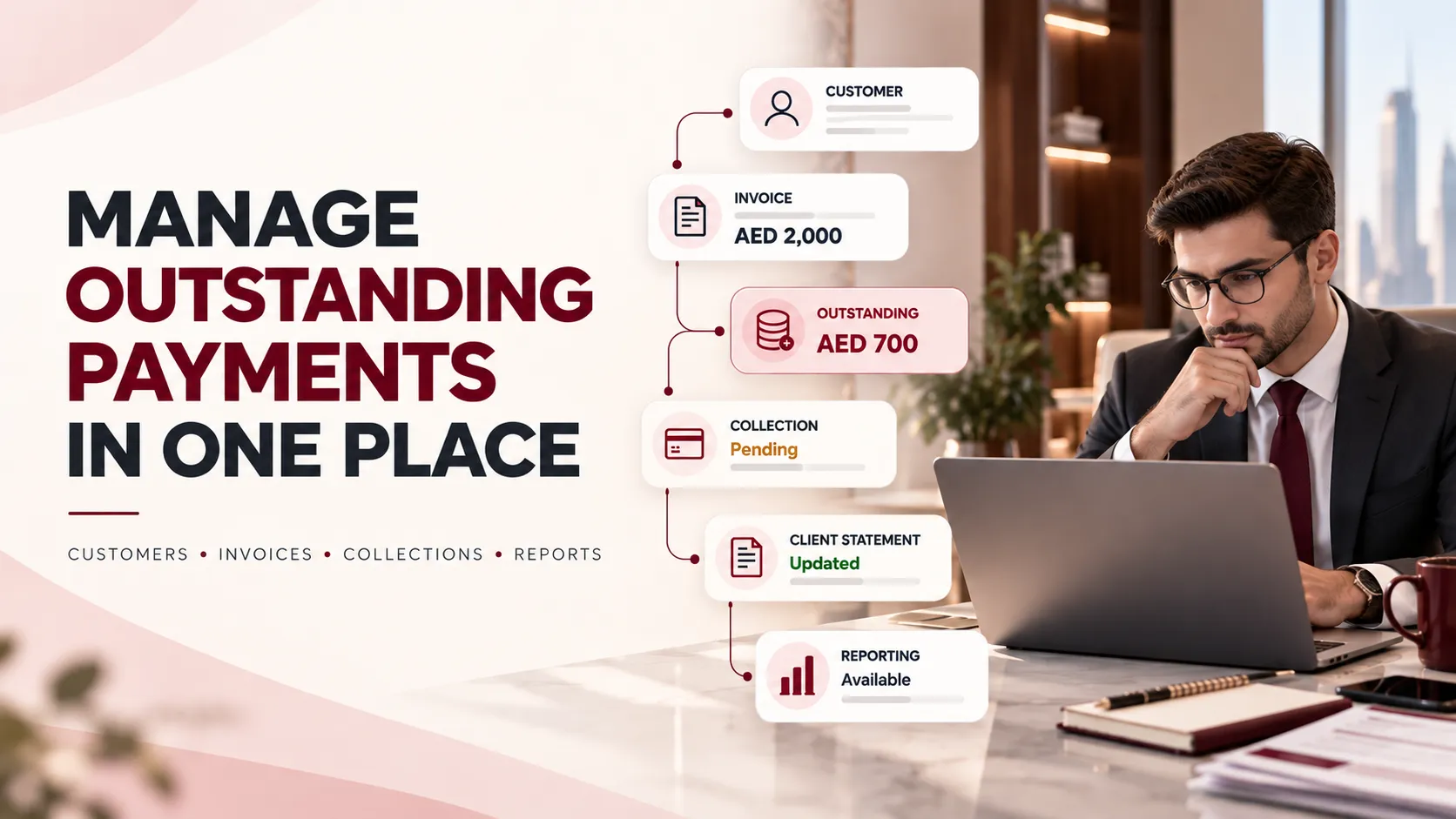
Customer → Invoice → Payment / Collection → Client Statement → Outstanding Balance → Reporting
Khadamath's documented reporting system includes a Client Statement, Collection Report and Customer Advances report, alongside other operational and financial reports. The software also includes invoicing and customer records.
These capabilities are relevant because payment visibility is connected to the wider service-business workflow rather than being treated as an isolated list of unpaid invoices.
Khadamath does not need to be the answer for every business. The useful comparison is whether the system's documented capabilities match the way your service business handles customers, billing, collections and reporting.
You can explore Khadamath's service-business management software to compare its documented capabilities with your workflow.
Conclusion
Tracking outstanding payments is not simply about maintaining a list of unpaid invoices. A service business needs a connected view of the customer, invoice, due date, payments received, remaining balance, status and follow-up activity.
Customer → Invoice → Due Date → Payment → Remaining Balance → Status → Follow-up → Collection → Reporting
When this workflow is organized, it becomes easier to see which balances are still open, which payments are overdue, which invoices are partially paid and what needs attention.
If your service business needs a more connected way to manage customers, billing, collections, statements and reporting, Khadamath is one service-business software option to evaluate against your actual workflow.
Ready to Keep Your Outstanding Payments Organized?
Keep customer balances, invoices, collections, client statements and payment information organized in one place with Khadamath.
See Khadamath in Action