Customer advances are common in service businesses. A customer may pay before a service is completed, before the final invoice is issued, or before the full amount is known. If these payments are recorded across spreadsheets, receipts and separate invoice records, it can become difficult to identify available balances and understand each customer's payment history.
For UAE service businesses, a consistent process for recording customer advances helps keep customer accounts organized, supports invoice reviews and makes it easier to identify balances that need attention.
What Is a Customer Advance?
A customer advance is money received from a customer before it has been fully applied to the relevant service or final invoice. It may be collected when a customer confirms a service, pays a deposit or makes an advance payment toward work that will be completed later.
A customer advance should not automatically be treated as an outstanding payment. An outstanding payment is an amount the customer still owes the business, while an advance is money the business has already received.
These amounts can exist at the same time. A customer might have paid an advance for one service while still owing money on another invoice. Keeping the transactions identifiable helps prevent confusion when reviewing the account.
Why Tracking Customer Advances Matters
When customer advances are not recorded consistently, employees may struggle to answer basic questions: How much has the customer paid? Which service was the payment intended for? Has any of the amount been applied to an invoice? Is there still a balance to collect?
A structured tracking process helps service businesses:
- Identify each advance and the customer who paid it.
- Keep payment receipts and transaction references available.
- Distinguish received money from amounts that are still due.
- Review invoices and customer balances with clearer records.
- Investigate old, incomplete or unusual balances.
- Give staff a consistent process for recording and reviewing transactions.
Customer advances are only one part of customer account management. Businesses should also maintain reliable customer details and transaction histories. Learn how to organize customer records for a service business to create a more consistent foundation for daily operations.
What Should You Record for Each Advance?
Each customer advance should have enough information for another authorized team member to understand the transaction without relying on memory or searching through unrelated records.
- Customer details: The customer name and a unique reference, where available.
- Payment date: When the money was received.
- Amount received: The exact amount recorded in the transaction.
- Payment method: Cash, bank transfer, card or another applicable method.
- Receipt or transaction reference: A reference that supports verification.
- Purpose: The service, booking or work for which the advance was received.
- Invoice relationship: Whether the advance has been applied to an invoice, remains unapplied or requires review.
- Remaining balance: The amount that remains available or requires further investigation, based on the business's accounting process.
Record corrections and adjustments with supporting references. This helps the team understand why a balance changed and makes later reviews easier.
How to Track Customer Advances Step by Step
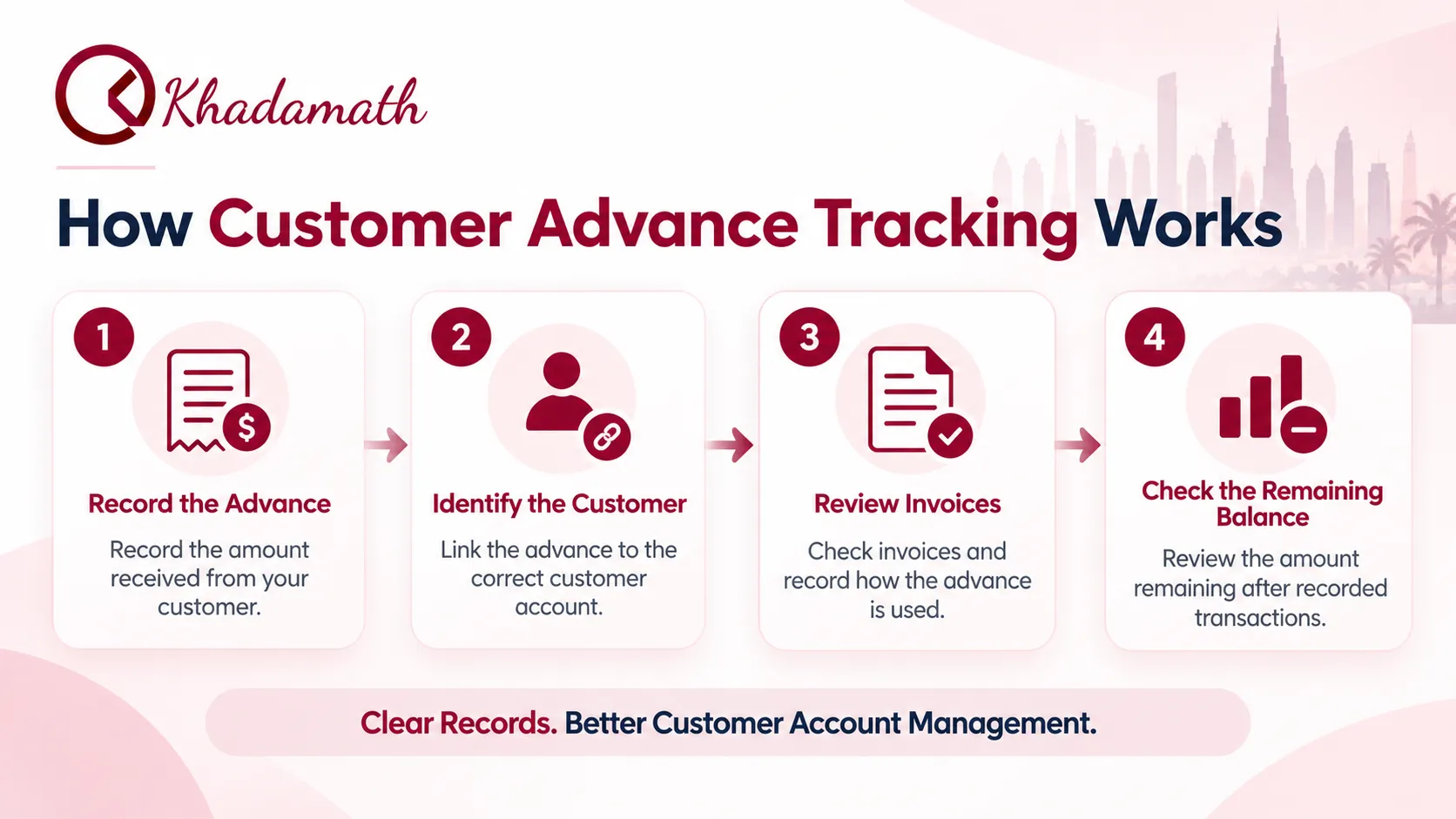
Step 1: Identify the Correct Customer
Start by locating the correct customer record before entering the advance. Check the customer name and any available customer reference to avoid recording the payment against the wrong account.
When customer information is spread across files or staff members maintain separate records, use a consistent process to organize customer records and make the transaction history easier to review.
Step 2: Record the Payment Details
Enter the amount received, date, payment method and available receipt or transaction reference. Record the purpose of the payment so the team can understand why the advance was collected.
A bank transfer reference or receipt can help support verification if a question arises later. Avoid relying only on informal notes or verbal confirmation.
Step 3: Connect the Advance to the Relevant Service
Where the purpose of the advance is known, record the relevant service, booking or work reference. This gives the team useful context when the service progresses or an invoice is prepared.
If the customer has several ongoing services, do not assume that every advance belongs to the oldest or largest invoice. Review the original purpose and the business's agreed process before allocating the amount.
Step 4: Review the Invoice and Payment Position
When an invoice is issued or a service is completed, review the customer's payment history and determine how the advance should be treated under your accounting process. Record any application or adjustment with a clear reference.
Keep the advance, invoice amount, payments received and remaining amount distinguishable in the records. Do not count the same receipt twice when reviewing total collections.
For a clearer view of how quotations and invoices work together in a service workflow, read our guide on managing quotations and invoices in one workflow.
Step 5: Review Remaining Balances and Outstanding Payments
After reviewing the relevant transactions, identify whether an advance remains unapplied, an invoice is still unpaid or the account needs further investigation. Check the supporting records before contacting the customer about an amount.
A customer may have an advance on one service and an unpaid invoice on another. Review the transactions separately instead of assuming that one balance automatically cancels the other.
For a related process, read our guide on how to track outstanding payments in a service business.
Step 6: Reconcile Records Regularly
Set a review schedule that matches the volume of transactions in your business. A business handling many daily receipts may review entries more frequently, while a smaller operation may use a different schedule supported by its accounting procedures.
During the review, look for missing references, duplicate entries, unexpected balances and advances that have remained open for a long time. Investigate differences and document any corrections.
A Simple Customer Advance Example
Consider a service business that receives an advance of AED 1,000 from a customer for an upcoming service.
- Advance received: AED 1,000
- Amount later applied to the relevant invoice: AED 700
- Remaining unapplied amount: AED 300
In this example, AED 300 remains unapplied after the AED 700 allocation. The business should keep the original receipt and the subsequent application identifiable so the remaining balance can be reviewed.
The example illustrates transaction tracking only. The correct accounting treatment depends on the underlying transaction and the business's accounting procedures.
Common Mistakes to Avoid
Recording an Advance Without a Customer Reference
An amount without a clear customer reference can be difficult to investigate. Record the customer details and supporting transaction reference when the payment is entered.
Confusing an Advance With an Outstanding Invoice
Money already received and money still owed are different positions. Review the transaction history before deciding whether an amount is available, unapplied or outstanding.
Using Separate Records Without a Clear Connection
When receipts, customer records and invoices are maintained separately, staff may need to search several places to understand one account. Use consistent customer references and document the relationship between relevant transactions.
Leaving Old Balances Unreviewed
An old balance may reflect a pending service, a missing invoice reference, an adjustment or a recording error. Review it and document the outcome instead of carrying it forward without explanation.
Failing to Record Adjustments
If an advance is applied or a balance is corrected, keep a record of the change and its supporting reference. This makes the account history easier to follow.
Spreadsheets vs. a Connected System
A spreadsheet can be sufficient for a small operation with a limited number of transactions and a clear review process. However, as customer records, invoices, services, staff and branches increase, maintaining consistent information across separate files can become more demanding.
A connected business-management system may provide a more structured place to maintain customer and billing information alongside other operational records. The right approach depends on transaction volume, team size, reporting needs and the workflow your business follows.
If your team is experiencing repeated data entry, scattered information or time-consuming reporting, explore these signs your service business has outgrown Excel.
It is also useful to understand the difference between tools designed mainly for product-based operations and those intended to support service workflows. Our guide to business management software for product vs. service businesses explains the distinction.
How Khadamath Supports Service Businesses
Khadamath Accounts & Operations is designed for service businesses that need to manage customer information, quotations, drafts, invoicing, work orders, expenses, suppliers, staff, branches and reports.
Its documented reporting features include Customer Advances, Client Statement and Collection Report, helping businesses review relevant customer and collection information within their operational workflow.
For teams reviewing how advance records fit into their wider billing process, it is also worth understanding how to organize billing and invoicing for a service business.
Explore Khadamath Accounts & Operations and its available plans to review the documented features and decide whether they fit your business's requirements.
Customer Advance Tracking Checklist
Use this checklist to review your current process:
- Every advance is recorded against the correct customer.
- Each receipt includes a date, amount, payment method and reference where available.
- The purpose of the advance is documented.
- Advance records can be distinguished from unpaid invoices.
- Applications or adjustments are recorded with supporting references.
- Customer statements and outstanding collection records are reviewed.
- Old or unusual balances are investigated.
- Corrections have an explanation and supporting reference.
- Staff know who records payments and who reviews them.
Conclusion
Customer advances are easier to manage when each receipt has a clear customer reference, a documented purpose and a traceable relationship to invoices and later services. Regular reviews help service businesses distinguish money already received from amounts that remain due.
For UAE service businesses looking to organize customer records, billing and reporting, a consistent tracking process—and a suitable business-management system—can provide a clearer foundation for daily operations.
Keep Customer Advances and Balances Organized
Connect customer records, invoicing, work orders and reporting with Khadamath Accounts & Operations, designed for the everyday needs of service businesses.
See Khadamath in Action