A customer record should be more than a name, phone number, and email address.
For a service business, organized customer records should help your team understand who the customer is, what services are associated with them, what has been quoted or invoiced, and what payment or account information needs attention.
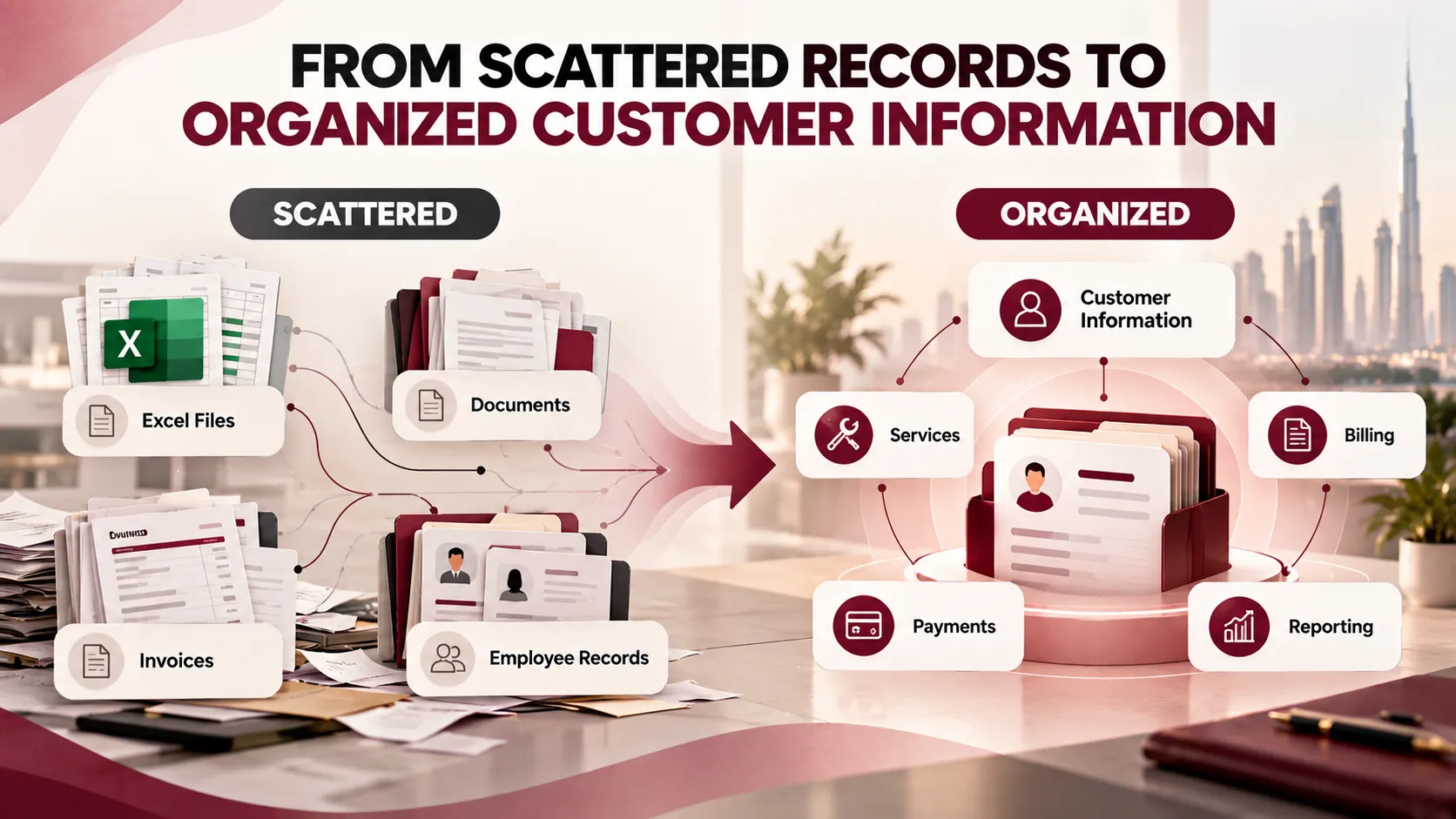
As a business grows, keeping this information across spreadsheets, separate files, invoices, messages, and individual employee records can make it harder to find the right information at the right time.
A better approach is to organize customer records around the way the business actually works.

What Is a Customer Record?
A customer record is a structured collection of information about a customer that a business uses to identify, serve, communicate with, and manage its relationship with that customer.
At a basic level, this can include contact and identification information.
For a service business, however, the record becomes more useful when it can be considered alongside the activity associated with that customer.
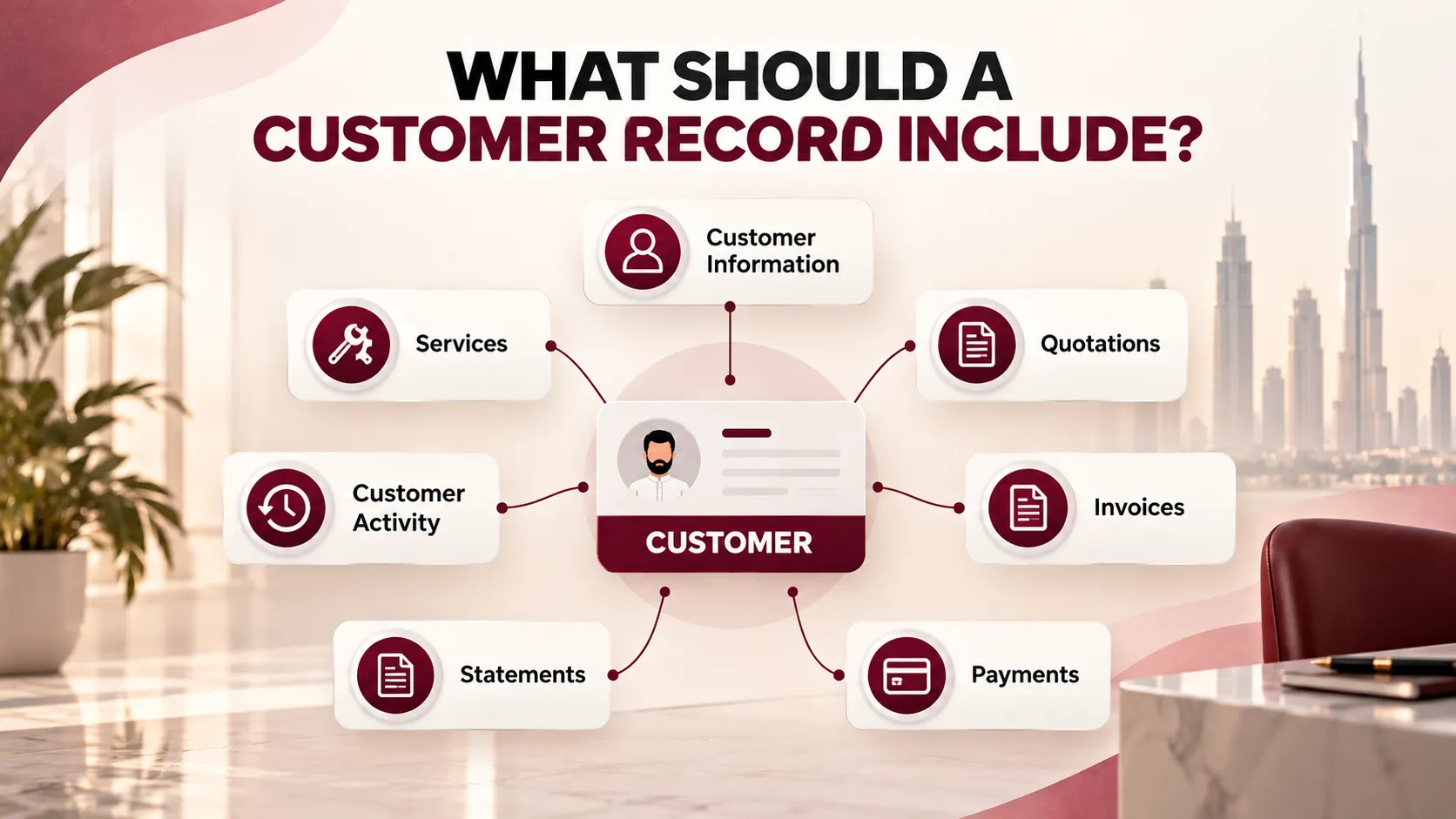
Depending on the business, that may include:
- Customer information
- Services provided
- Quotations
- Invoices
- Payment information
- Outstanding amounts
- Customer statements
- Advances or balances
- Customer activity or status
The goal is not to collect every possible piece of information.
The goal is to make the information you actually need organized, accessible, and useful for daily operations.
Why Customer Records Become Difficult to Manage as a Service Business Grows
Managing a small number of customers manually may be relatively simple.
The problem usually appears when the number of customers, services, invoices, employees, and transactions increases.
Customer information becomes scattered
A customer name might be in an Excel file, their phone number in another document, their quotation in a separate folder, and their payment information somewhere else.
Finding the complete picture can then take more time than maintaining the record itself.
Different employees may maintain different information
When several people handle customers, inconsistent records can develop.
One employee may update a phone number while another continues using an older version. Someone may know about a previous service while another employee cannot easily find it.
Service and billing information become disconnected
A customer record is more useful when the business can understand the activity associated with that customer.
If service information and billing records are maintained separately, employees may need to search multiple places to understand what happened.
Payment information becomes harder to track
Service businesses often need to know which customers have unpaid amounts, what has already been collected, or whether a customer has an advance or other balance.
When this information is maintained manually, follow-up can become more difficult.
For a deeper look at this specific problem, see our guide on outstanding payments in a service business .
Older customers can become difficult to identify
A business may have many customers who have not used its services recently.
Without a clear way to review customer activity, those customers can become difficult to distinguish from active customers.
What Should a Service Business Include in a Customer Record?
There is no single structure that works for every service business.
However, a useful customer-record system should make it possible to organize the information that matters to the way the business operates.
Basic customer information
Start with the information your team actually needs to identify and communicate with the customer.
Keep the information consistent so employees can search for and recognize customers easily.
Services and service history
For a service business, knowing what was done for a customer can be more useful than simply knowing who the customer is.
Service history can provide context when the customer returns, asks a question, requests another quotation, or needs information about previous work.
Quotations and invoices
Customer information often needs to be considered alongside the commercial activity associated with that customer.
Quotations show what was proposed, while invoices record what was billed.
Keeping these connected to the customer context makes it easier to understand the relationship between the customer and the work performed.
For more on organizing quotations, see our guide to quotation management for service businesses .
Payments and outstanding amounts
Payment information is another important part of customer management.
A business may need to know whether an invoice has been paid, whether an amount is still outstanding, or whether further collection follow-up is necessary.
Customer statements and advances
A customer statement can provide a broader view of customer-related billing activity.
Customer advances or balances may also be important depending on the business model.
The more financial activity a service business handles, the more useful it becomes to keep this information organized rather than relying on separate manual records.
Customer activity or status
Not every customer has the same level of activity.
Being able to distinguish active customers from customers who have become inactive can help a business understand its customer base and decide where further attention may be appropriate.
How to Organize Customer Records Step by Step
1. Keep one primary record for each customer
Avoid maintaining multiple disconnected records for the same customer whenever possible.
A consistent primary record gives employees a common reference point.
This is especially important when more than one person deals with the same customer.
2. Standardize the information you maintain
Decide what information your business actually needs and use consistent formats.
For example, avoid having different employees record the same type of information in completely different ways.
The objective is simple:
Make customer information predictable and easy to understand.
3. Connect customer records with service activity
A customer record becomes more useful when it provides context about the services associated with that customer.
Instead of treating the customer database as a standalone contact list, think about how it relates to the actual work your business performs.
4. Keep billing information connected to the customer
Customer management and billing are often closely related in a service business.
When quotations, invoices, payments, and collections are maintained in isolation, employees may have to switch between different records to understand a customer's position.
Organizing these activities around the customer makes the information easier to use.
For businesses looking to improve their overall billing process, see our guide to billing and invoicing for service businesses .
5. Keep records updated
A customer database can become less useful when information is outdated.
Review important information regularly and correct information that is no longer accurate.
The objective is not simply to have a large database.
It is to have a useful database.
6. Identify inactive customers
Not every customer will remain active indefinitely.
Reviewing customer activity can help identify customers who have become inactive and give the business a clearer understanding of its current customer base.
However, identifying inactive customers is different from having an automated customer-retention campaign. A reporting system can help identify inactive customers without automatically managing the follow-up process.
7. Control staff access
As more employees work with customer information, businesses should consider who needs access to which information.
A centralized system can make access management more structured than sharing multiple spreadsheets or files between employees.
The exact access requirements will depend on the business, its employees, and its operating structure.
8. Review customer data regularly
Customer records should not be treated as something that is created once and forgotten.
Review them periodically to identify outdated information, incomplete records, inactive customers, and other issues that reduce the usefulness of the database.
Excel vs. a Centralized Customer Management System
Excel can be useful for simple customer records.
It is flexible, familiar, and easy to start with.
The challenge appears when the business begins using spreadsheets for increasingly complex customer and operational information.
| Excel or manual records | Centralized system |
|---|---|
| Easy to start | Designed for ongoing structured management |
| Flexible for simple lists | Can organize customer information within a wider system |
| Information may become scattered across files | Information can be maintained in a centralized environment |
| Updates may depend heavily on individual employees | Users can work within defined system access |
| Billing and customer information may be separated | Customer activity can be connected with relevant business modules |
| Reports may require manual preparation | Dedicated reporting can provide structured visibility |
This does not mean every business needs to stop using Excel immediately.
The better question is:
Has the business reached a point where manual customer records are creating more work than they save?
If the answer is yes, it may be time to consider a centralized system.
For a broader look at the signs that a service business may have reached this point, read 5 Signs Your Service Business Has Outgrown Excel .
When Should a Service Business Move Beyond Basic Customer Records?
There is no universal customer count at which a business must adopt software.
Instead, look at the complexity of the work.
A centralized system may become more useful when:
- Customer information is difficult to find.
- Multiple employees maintain customer information.
- Customer billing history is scattered.
- Outstanding payments require repeated manual checking.
- Customer statements are difficult to prepare.
- Customer advances or balances need regular tracking.
- Inactive customers are difficult to identify.
- The business operates across multiple branches.
- Management needs structured reports.
- Quotations, invoices, and customer information are maintained separately.
At this point, the problem is no longer simply storing customer data.
It is managing the relationship between customer information and the business activity surrounding it.
How Khadamath Helps Organize Customer Information
For a service business that has moved beyond a basic customer list, the next question is how customer information can fit into the wider business workflow.
Khadamath Accounts & Operations provides customer/client records alongside capabilities such as client statements, inactive-client reporting, customer advances, collection reporting, and customer-related billing.
The software also supports quotations, draft-based invoicing, invoicing, receipts, statements, collections and financial reporting.
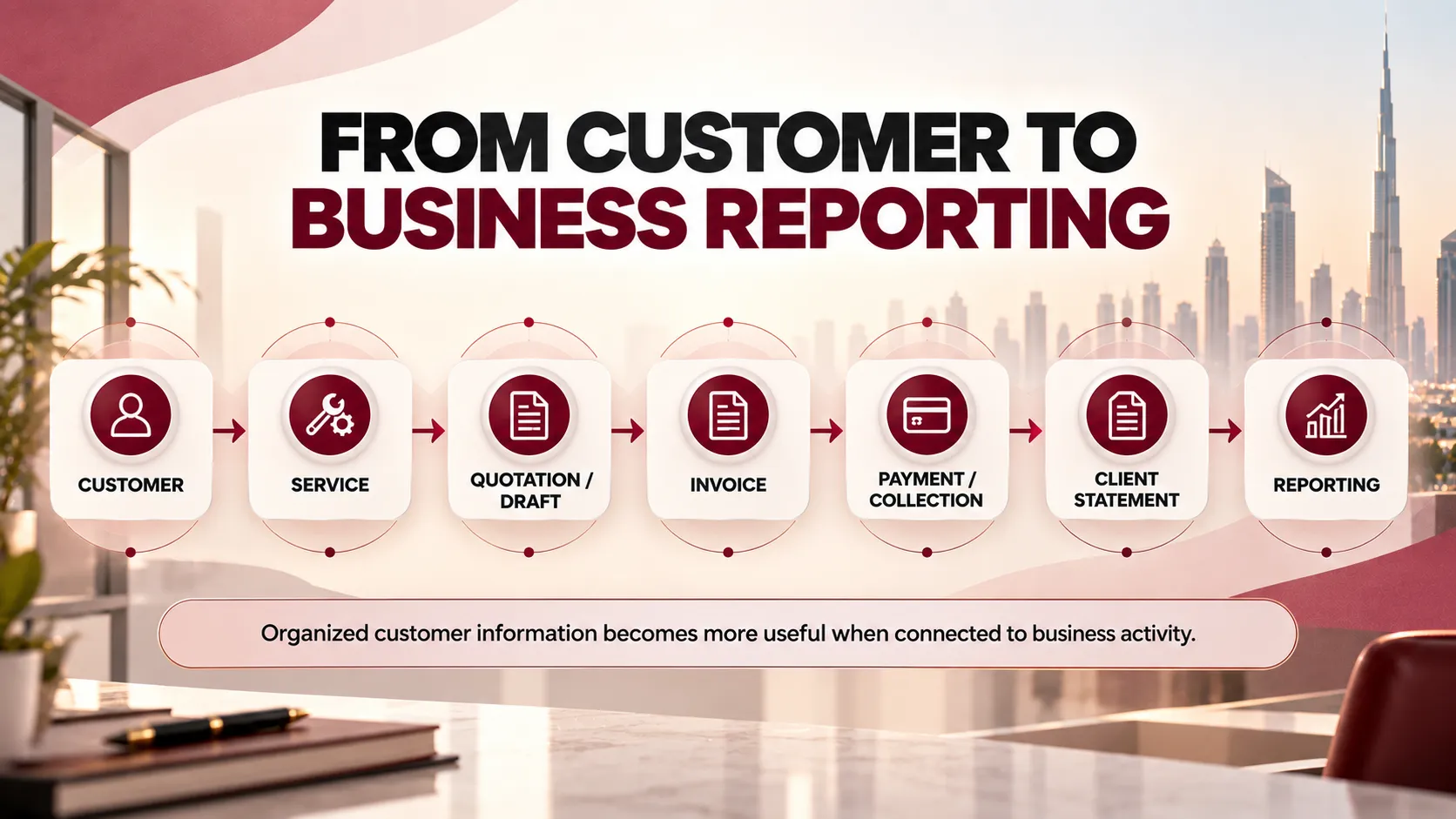
A useful way to visualize these connected capabilities is:
Customer → Service → Quotation / Draft → Invoice → Payment / Collection → Client Statement → Reporting
This is a practical representation of how the different business modules relate. The exact workflow used by a business can vary depending on its operations.
Khadamath also provides reporting related to customer and business activity, including client statements, collection reports, inactive clients and customer advances.
For a growing service business, that broader context can be more useful than simply maintaining a list of customer names.
Manage More Than Just Customer Records
Connect customers, services, quotations, drafts, invoicing, collections, statements and reporting in one connected platform with Khadamath.
See Khadamath in ActionCustomer Record Organization Checklist
Before considering your customer records well organized, ask:
- Can the team quickly identify each customer?
- Is customer information maintained consistently?
- Can employees understand the services associated with a customer?
- Can related quotations and invoices be found easily?
- Can the business check payment or collection status?
- Can customer statements be accessed when needed?
- Can relevant customer advances or balances be tracked?
- Can inactive customers be identified?
- Can authorized employees access the information they need?
- Can management obtain useful reports from the records?
If several answers are “no,” the problem may not simply be the customer database.
It may be the way customer information is connected to the rest of the business.
Conclusion
Organizing customer records is not simply about creating a cleaner list of names and phone numbers.
For a service business, the real value comes from creating a reliable view of the customer and the business activity connected to that relationship.
That means organizing customer information alongside relevant services, quotations, invoices, payments, statements, advances, and customer activity.
As the business grows, spreadsheets and disconnected records may become harder to maintain. At that point, a centralized service-business system can provide a more structured way to manage customer information and the operations surrounding it.
If your business is reaching that stage, Khadamath Accounts & Operations is worth exploring for bringing customer management together with billing, collections, statements, and broader service-business operations.